

The last time I went without caching for about a month, a few of the local cachers noticed. Except for my Geowoodstock Trip at the end of May, I haven't been doing much caching lately. I think every cacher probably goes through "dry spells." For me right now, this includes transportation (gas, and my truck isn't in the best condition to do much driving), other things in life (trying to find a job), heat (summer in New Mexico limits caching severly - I don't want to do any all-day hikes when it gets to triple digits in the afternoon), and finally not many caches to choose from (I've found the majority of caches in the area, except for the more difficult ones I've had trouble with in the past, leaving me to travel for more unfound caches).
What does one do while in a dry spell? This is a chance to explore some "armchair caches," caches that can be done remotely (through a computer). This also lets me do some waymarking. Waymarking involves mostly taking photographs of sites, as well as recording the coordinates- which takes much less time than finding a cache. It can also be done easily while running errands: simply snap the photo.
It also leaves me a chance to plan for upcoming caches to place. I have one rather long multi-puzzle cache I've been planning, but just haven't had to time to fine-tune it. It will involve solving many puzzles and require traveling throughout the region to complete. I've also wanted to finish my "ABC's of Geocaching" series (which I'll describe in another blog).
For those with limited time, this could be a good chance to collect materials for caches. While cleaning around the house, for example, keep an eye out for what could be a good container. Organize your existing caching materials. If you want to actually go out and cache, this seems to be the reason a lot of urban caches exist. One common urban cache is the "lampskirt." They all are fairly easy to find, but do offer the chance to at least get out of the house and find a cache. Sometimes that's a nice feeling, just to get in the "caching zone" again.
24 June 2008

02 June 2008
Geowoowoodstock VI

 Last week, I flew out to California for Geowoodstock VI. I spent most of my time on this week-long adventure between San Mateo and San Francisco to get use out of the free accommodation (my brother lives in the area). On Saturday, we headed out for Geowoodstock VI in Wheatland, just north of Sacramento.
It was amazingly fun. There were lots of geocaching-related vendors, selling geocoins, caches, GPS units, shirts, car accessories, anything that might be appealing to geoca
 chers. I'm amazed I didn't go into debt just from looking around. Throughout the day, there were many classes being offered, such as using a GPS unit, using a map and compass, various software programs (such as GSAK), hiking, etc. There were also lots of games, ranging from panning for gold to hunting for geocoins using a metal dector (that was fun). Geobingo was a bit of a challenge. You had to find cach
 ers who met certain criteria, such as having 5000 finds, being from out of state, caching since 2001, and so forth. I somehow managed to complete mine to get many raffle tickets. Music was playing throughout the day, and lots of interesting cachers were there waiting to be met (including one oddly green cacher).
One of the other interesting sites included the original can of beans, which was a trading item put into the first geocache. I'm not sure I'd want to eat any of thos
 e beans after this time, but it was at least interesting to see it,
Next year's Geowoodstock will be in Bell Buckle, TN, which is approximately an hour's drive from Nashville, according to Google Maps. It was certainly fun to attend with lots to do. I don't know if I'd set this as a high priority to attend another one, since I have a feeling the next one would be just like this. It's definitely worth going to once, though. I'm sure each one has it's own
 flavor and is equally fun, but once is enough to say I've been to Geowoodstock.
29 April 2008
Geocaching camera and water caches
I've been looking for a new camera lately. One that really seems interesting is the Olympus Stylus 850 SW. It's shockproof, waterproof, and dustproof. This makes it one rugged camera- perfect for geocaching. What's neat is that you could drop it (from 5 feet) and it'd be fine. You can even take it underwater up to 10 feet (the Olympus Stylus 1030 SW can go down to 33 feet- in addition, the 1030 is crushproof to 220 lbs).
 That got me thinking about water caches. I've only had to wade through water to get to one cache (ignoring rain, or simply taking a bad route): The Gates of Mordor, in which I had to cross the Rio Grande (there is no public bridge to that side at that particular spot). Imagine how great a waterproof camera would have been. I could have put the camera in the river to take a picture of any fish that were there (probably not that many, considering how low the river was). I still got some good shots without doing that (my log), though- just nothing underwater. It's also a good thing I didn't drop my camera into the water (another good thing if I had this camera).
It'd be fun to go out and do a cache I actually had to swim to. Living in New Mexico, however, there aren't many caches that are "water caches." There's one at Elephant Butte (Namesake Cache) that you have to take a boat to get to. Maybe if I move or visit some place a bit more wet, I'll be able to get to a wet cache. Hopefully by then I'll have a camera suitable for the adventure.
 That got me thinking about water caches. I've only had to wade through water to get to one cache (ignoring rain, or simply taking a bad route): The Gates of Mordor, in which I had to cross the Rio Grande (there is no public bridge to that side at that particular spot). Imagine how great a waterproof camera would have been. I could have put the camera in the river to take a picture of any fish that were there (probably not that many, considering how low the river was). I still got some good shots without doing that (my log), though- just nothing underwater. It's also a good thing I didn't drop my camera into the water (another good thing if I had this camera).
It'd be fun to go out and do a cache I actually had to swim to. Living in New Mexico, however, there aren't many caches that are "water caches." There's one at Elephant Butte (Namesake Cache) that you have to take a boat to get to. Maybe if I move or visit some place a bit more wet, I'll be able to get to a wet cache. Hopefully by then I'll have a camera suitable for the adventure.
27 April 2008
Cachmobiles
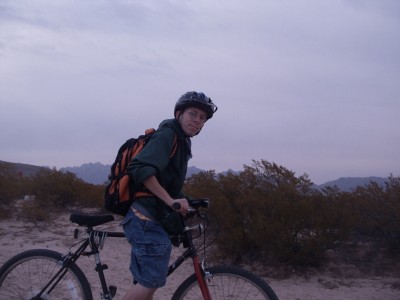 Although for many (most?) caches, I've gotten there by the amazing luck that my truck would make it, I've also gotten to caches by bike (in addition to walking- but let's not go there). A few weeks ago, I rode my bike out 4 miles (8 miles round-trip) to get a cache. I have a feeling if I had driven to the area and just walked the last 600 feet to get to the cache, it wouldn't have been nearly as rewarding. I still would have found the cache, sure- but there's just something of an accomplishment of going 8 miles to find a cache. I think by having more energy and effort that goes into doing a hobby, more is gotten from it. In this case, I was able to get out of the house, get some exercise, and get a sense of achievement. Driving doesn't really allow for that. It is necessary to do though, particularly for the more remote caches- often which are rewarding in their own right.
In May, I'll be visiting San Francisco (en route to Geowoodstock VI in Sacramento). While in the area, I'm hoping to spend one day on Angel Island. There are about 40 caches there. The best part is that I should be able to rent a bike for the day. I think riding my bike to get 40 caches in a day is an ambitious goal. Driving to those caches would still be an accomplishment- but there's just something about that extra effort. I guess because even more goes into finding those caches than just finding the caches. The bike riding is its own special accomplishment, combined with geocaching, making it all the more great. It's the same with hiking and geocaching. They just go great together.
23 April 2008
FTF: First to Finally realize there's an addiction?
In my area, I've become well known. There are many reasons for this: my kilt, the events I've thrown, some evil caches, riding my bike around, and perhaps even some of the logs I write. One other thing I'm known for: being the first to find.
I'll admit it. I'm somewhat of a FTF hound. Right now, I have about 55 first to finds out of 505 total finds - almost 11% of my finds are FTFs. Do those numbers actually mean anything? Not at all. In fact, recently I've been trying not to put so much emphasis on actually being there first. It's all entirely random who is the first to find. It's all about who has the most free time (I happen to have a very flexible schedule right now), who happens to be available at the moment, and who just happened to check their e-mail at the right time. It really is all coincidental. It doesn't matter if I find the cache first or tenth. It's still located at the same place and still ends up getting me out of the house to do something I enjoy.
I still go for FTFs, however, because I've found most of the caches in the area- except for the "trouble" caches, or ones I just haven't been able to get to for whatever reason. A new cache means I can once again go out to geocache, instead of just staying inside all day. That's my big motivation. Plus, there are some fun stories about getting there first- since you have no one's experience to base yours off of. You might get stuck because you didn't know about a certain hole in the road, or get lost because you couldn't find the turn off. There's also the fun of meeting other geocachers attempting to get a FTF. It seems more likely there will be more geocachers at a new cache than one that's been around for a while- although I have met up with cachers randomly at older caches.
I guess my overall view of a FTF is that it can be fun, and for those who have found the majority of the caches in an area, it almost becomes a necessity to continue caching- perhaps not being first to find, but certainly going after the new caches. It shouldn't be a big deal, however, since it really is almost random and circumstantial as to who actually gets to the cache first.
I'll admit it. I'm somewhat of a FTF hound. Right now, I have about 55 first to finds out of 505 total finds - almost 11% of my finds are FTFs. Do those numbers actually mean anything? Not at all. In fact, recently I've been trying not to put so much emphasis on actually being there first. It's all entirely random who is the first to find. It's all about who has the most free time (I happen to have a very flexible schedule right now), who happens to be available at the moment, and who just happened to check their e-mail at the right time. It really is all coincidental. It doesn't matter if I find the cache first or tenth. It's still located at the same place and still ends up getting me out of the house to do something I enjoy.
I still go for FTFs, however, because I've found most of the caches in the area- except for the "trouble" caches, or ones I just haven't been able to get to for whatever reason. A new cache means I can once again go out to geocache, instead of just staying inside all day. That's my big motivation. Plus, there are some fun stories about getting there first- since you have no one's experience to base yours off of. You might get stuck because you didn't know about a certain hole in the road, or get lost because you couldn't find the turn off. There's also the fun of meeting other geocachers attempting to get a FTF. It seems more likely there will be more geocachers at a new cache than one that's been around for a while- although I have met up with cachers randomly at older caches.
I guess my overall view of a FTF is that it can be fun, and for those who have found the majority of the caches in an area, it almost becomes a necessity to continue caching- perhaps not being first to find, but certainly going after the new caches. It shouldn't be a big deal, however, since it really is almost random and circumstantial as to who actually gets to the cache first.
12 April 2008
Origins: Mowhawk Mesa
 An interesting thing happened to me recently: I have in my possession the very first cache I found. I finally made it back to that "first time": Mowhawk Mesa, Crack in the Earth Cache (note it's not an "earthcache"- there's a space between the words). I even picked up a souvineer: the cache itself. As it turned out, the container has been retaining water. While it doesn't rain too much here, it does every so often. When that happens, water fills up in the container.
 It's actually a nice container with no holes in it. The lid just isn't water-sealed, and looks like it can come off easily (not to mention the fact that we found the container with the lid off).
It was nice being in the area again. It's not just that it's a really nice area (although it is- amazing) with some really cool geologic features (going through a slot canyon is quite the adventure). It's just something about that "first cache" that creates something special about the place.
I'm just glad I was able to actually replace the cache. It's in a less interesting container (a standard ammo can), but at least it won't retain water when it rains in a few months.
 Mowhawk Mesa, alone is interesting in just the way it's shaped. It's not a very big mesa (maybe 10 feet by 100 feet- max); although from one side, it is steep.
The big draw to the area is the slot canyon. A slot canyon is essentially a very narrow and deep canyon. It's probably only 5 feet wide- which means it's just barely big enough to walk through, and especially difficult if you have a backpack on or are carrying anything (like the original cache container). It's full of lots of turns, making it difficult to get through.

In these slot canyons, it's also rather dark. Just because of how deep they are (50+ feet) and how
 narrow they are, sunlight doesn't get in so well. That makes the insides of these canyons dark and (literally) cool.
There are also some drop-offs that are fun to try and get around. In the slot canyon I was in, it emptied into a bigger one. My friend and I thought long and hard about whether to try and drop down or go a long way around.
 If we did that, it'd mean going back through the slot canyon up over a few hills, and then trying to find a way into the bigger canyon... although we, at the time, didn't know if that bigger canyon would also have some drop-offs. We finally decided to do it. It was about a 10-foot drop-off to the bottom of a semi-circular ledge, followed by another 5-foot into the bigger canyon. Probably not the best idea to actually go down that. We made it out without injury, however.
26 March 2008
Statistics links
Is it about the numbers for you? Check out these sites.
Links
Links
- Cacherstats.com - Listing of geocachers with 200+ finds
- Itsnotaboutthenumbers.com - Generates caching statistics, like the above images
- CacheStats - software from LogicWeave to generate similar geocaching stats (with the advantage of having the stats on your computer, and not on a website like itsnotaboutthenumbers.com)
- FindStats - software for stats
- Zinnware's Geocaching page - contains his personal stats, plus the cachers with the most finds and the cachers with the most hides.
- Deep Southwest Geocaching - Displays lots of stats for the southwest
Subscribe to:
Posts (Atom)

